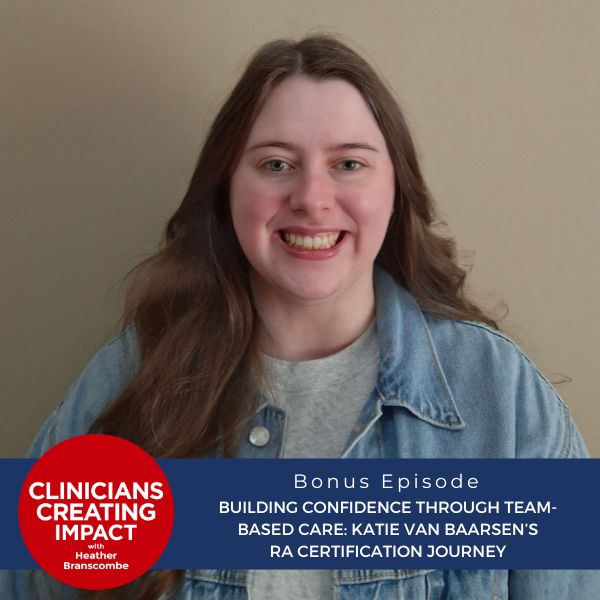
Bonus episode: Building Confidence Through Team-Based Care: Katie van Baarsen’s RA Certification Journey.
Welcome to Clinicians Creating Impact, a show for physical therapists, occupational therapists, and speech-language pathologists looking to take the next step in their careers and make a real difference in the lives of their clients. If you’re looking to improve the lives of neurodiverse children and families with neurological-based challenges, grow your own business, or simply show up to help clients, this is the show for you.
Welcome back to the Clinicians Creating Impact podcast. Today’s episode is a special bonus episode. Today I’m joined by Katie van Baarsen, a speech language pathologist who’s been working with us at Abilities and who recently completed our rehabilitation assistant certification program at the end of 2025. This certification, as I’ve talked about in the past year, it’s optional, it’s rigorous, and it’s deeply practical, and completing it is no small accomplishment. Katie brings such thoughtfulness, humility, and curiosity to her work. And in this conversation, we explore what surprised her most about the program, how her clinical confidence and decision making has evolved, and what it really looks like to collaborate with rehab assistants in a team based care model.
We also dive into real client examples, moments of growth, and what Katie would say to clinicians who feel unsure about working with rehabilitation assistance. So if you’re curious about delegation, collaboration, or how to expand your impact without compromising quality of care, this episode is for you. Let’s dive in.
All right. Welcome, Katie, to the podcast. Maybe if you can start, tell us a little bit about who you are, what you do, and where you do it.
Katie: Okay. I’m Katie. I am an SLP who works at Abilities. I’ve been working since September 2024, and I got my master’s degree at UBC.
Heather: Awesome. And you were a student with us before, hey?
Katie: I was.
Heather: Your last placement. So, you recently completed our rehabilitation assistant certification program. Do you remember how you first heard about it?
Katie: You sent an email about it to everyone in the company and said, “Oh, we have this course. This is the second time we’re doing it. It went really well the first time. It’d be great if you could join in.”
Heather: Okay, amazing. And you’re right because we do have an asynchronous one where people can do it online, but I always like to put it out there that if I’m doing it, I’m trying to do it once a year to upgrade the program every year. So I’m glad you came. And so, when did you start the program?
Katie: January 2025. And then I finished very recently. I finished in November.
Heather: Okay, amazing. So, first of all, I know this isn’t the first time I’m telling you, but I’ll tell you on the podcast again, congratulations. It’s no small accomplishment. It took you 11 months, and there are many components. This isn’t here to sell the program, but I’m really excited to talk to you about your experience. So, first of all, what surprised you most about completing the certification program?
Katie: I think what surprised me the most was it was really thorough. There were so many steps. You did coursework. You could attend the coursework via Zoom or watch the recording. You had to get feedback from a rehab assistant, from clinic admin, and there was also a practicum. And I was like, oh my gosh, is this grad school again? Wow.
Heather: I do. We set that up intentionally because we do love some thoroughness, and it’s a transformation ultimately. That’s the intention of it. So with that in mind, I know we’ve talked in the past about that there’s been some shifts. Upon reflection, what shifts have you noticed, and even notice now, a few months post certification, in your confidence or in your clinical thinking?
Katie: I think I’m a lot more confident, and I’m a lot more mindful about best fits for therapy. Am I a good fit for the client? Are one of the RAs more suited? There are funding considerations. I’m way more considerate of that, and I feel like in general, my confidence and my ability to support RAs and clients have increased, and also my confidence to just pitch that as an option to the parents. Because I know when I first did it, I’d be like, oh, I don’t know all the details still. I’m still getting used to what to say to them or how the process goes. And now that I’ve done it a few times, I’m like, oh, easy peasy. I can tell you all the details about it right now.
Heather: Amazing. Is there a moment when you think back where something really clicked for you to help you complete this experience in the way that you just described it?
Katie: I think after I did my first supervision for a rehab assistant, both I did an overlap and then I also did the indirect where they recorded it and then I viewed it at a later time. And I feel like that’s when I was like, “Oh yeah, I get this,” because it was the end step of it. First you tell the parent, “Oh, do you want to do this?” And then you set it up. You have a client care meeting to chat with the RA, and then they start seeing them, and then they record the video. So it was the last step. So once I had that, I felt I had a good model of what to expect and what to do for the entire process.
Heather: Gotcha. And so when you say it clicked for you, like “I got it,” what came to you? What did you get at that moment?
Katie: I think before I was really uncertain. I was like, “Oh, am I doing this right? I don’t know. I took a course, but am I doing this right?” I think I am, but then I was like, “No, I understand exactly what to do. I’m doing this in a way that is best for the clients, best for me, and a way that helps everyone.” And that’s how I was like, “Oh yeah, I get it.”
Heather: I think that’s really helpful and it causes me to go back for a moment because again, you’re working with us, you did your last placement with us, and then you started with us in your first position. Can you speak a little bit about how much of anything you learned about working with rehabilitation assistants in your program?
Katie: In grad school, we didn’t learn anything about it. I don’t know if it’s a common thing even talked about in grad school. I think they more focus on you being a clinician on how you can use rehab assistants or SLPAs in your treatment plan. I was an SLPA assistant before I went to grad school, so I knew about it through that, but I think other than that, we never chatted about it at in school.
Heather: Yeah. And so coming out of school, what were your initial, if you think back, what was your initial thoughts? How excited were you or not excited were you in working with rehabilitation assistance? What felt like some of the barriers, if there were any barriers for you?
Katie: Yeah, I think it maybe because I was a new grad. I’m still, once you’re out as you have your first big girl SLP job and you’re out in the world, you’re still learning so much in the first three months. And then I was like, “Oh my gosh, I’m still learning how to be a big girl clinician, and I have decided to also learn how to take on supporting rehab assistants.” And so I feel I had a lot of uncertainty because I was still uncertain about how I do things as a clinician myself. So I was like, “Well, how am I going to be able to support, am I going to be able to support them well, because I’m still figuring it out.”
Heather: And so, if you were to go and talk to a new grad who was saying that, what would you say to that new grad self, knowing what you know now? Can you grow in a leadership role while you’re still figuring it out on your own?
Katie: Oh, yeah, you totally can. I feel challenging yourself to do hard things is probably the best way that you can grow your skills the fastest. Because as you grow your skill, you go up on a curve, but once you challenge yourself more, that curve goes up faster. And I feel even if you’re unsure about it, you shouldn’t feel pressured to do it right away. Do it at your own time and your own pace. But I feel it’s such a valuable experience because for example, you get to see the client who you’re considering for the RA to see, and you have to make goals right away. And you’re like, “Oh, I have to make good goals.” In the beginning, I was like, “Oh, are these good goals? I don’t know.” But later on I was like, “Oh, these are the best goals that I was able to come up after one visit.” And it’s very collaborative. You can chat to the RA like, “Tell me if these goals are horrible and we can change it. We can make plans to come up with better goals. What are you noticing?”
Heather: Yeah, it sounds like one of the things that it really allowed you to grow in, and you can tell me if I’m wrong, is that it allowed you to grow in your area to be able to move forward in uncertainty.
Katie: Yes, I totally agree with that.
Heather: Going back to the certification program, is there part of the program that stretched you in a good way?
Katie: I think back to what I said of it really stretched my clinical thinking in that I was forced to think of these goals. Sometimes when you’re not too sure of what to do, you’re like, “Oh, I’ll see them next time. It’s fine. I can figure it out then.” I’m like, “Well, I don’t have next time.” I could if I really needed to. Like if I was like, we did nothing, I really need something. But to make the most out of their funding and have that transition, one visit’s pretty good. So I think I had to be really on top of my clinical thinking. I had to consider what I was seeing from the client as well as what the parent reported.
And a thing that really helps me is even if I’m not too sure, I’ll ask the parent, “Oh, what do you think the most important thing is that we work on?” And I usually try to make goals around that because that’s something they’re noticing at home. Even if I didn’t see it that day, I’m like, “Well, they’re saying this is something that their child has difficulty in.” So it’s definitely something we can work on until I’m able to supervise more and maybe see, “Oh, this goal would actually be really great.”
Heather: Amazing. Again, you’ve mentioned working collaboratively briefly with the rehabilitation assistants and working with the families. How do you think your understanding of team-based care has changed over the past year?
Katie: I think the idea of team-based care, even in grad school, they talk about it, it’s very interdisciplinary, but it’s usually among other therapists, so PT, OT. Even in a hospital setting, they’re like, “Oh, the respiration therapist.” It was never, “Oh yeah, and the rehab assistant.” Never. And so I feel that’s really shifted in that now I view it as, “Oh, it’s the PT, the OT, and the rehab assistant.” What do they bring to the table? And I think I rely on feedback from the rehab assistant in the sessions a lot. I have this one client who’s seeing a rehab assistant, and he’s using all AAC to communicate.
And they don’t have an iPad at home, they just do it here. And so the rehab assistant’s like, “Oh, I don’t really, I’m concerned about the benefit of using it because he’s only using in this one instance.” And that’s such a fair and valid point. And I was like, “Oh, thanks for bringing that up. That’s something really important to consider.” And the kid’s talking more, but I was like, he’s quite unintelligible, so I was like, we’ll still try using it. Maybe eventually with the funding, closer to the end of the year, we’ll try to get him his own device. But that’s such a great point for the rehab assistant to bring up and such a valid thing because I’m sure the parent might be thinking that too. So it’s really nice to have those things come to you and be addressed.
Heather: So what do you think that experience taught you about team-based care?
Katie: That team-based care can include anyone. It could even include the parents. It’s not just the therapist. There’s a big circle and a big wealth of knowledge that you can get from so many different people in the team.
Heather: Yeah, I can see that you’re taking the information from all that, and obviously you’re doing your part of taking all these signals, if we want to call them that, and then you’re interpreting them using your clinical interpretation to make a decision and then give some direction and decision out. But that’s what I hear from you, that it’s not just laterally from other therapists, but it can include rehabilitation assistants and what I’m hearing from you is other people as well. That’s amazing. And so what does collaboration with rehab assistants look for you now?
Katie: I think it’s listening to their ideas, me giving them suggestions, them giving me suggestions on goals and treatment ideas. I think it’s really hard sometimes when you’re the clinician and you have an idea of how you’re going to do the session if you saw them and then the rehab assistant comes to you and says something different. And then you’re like, “Oh,” and you have to think, “We listen, but we don’t judge.” I want them to succeed. I want them to try it to see if it works. Sure I think there’s a way to do it, but there’s a bunch of other right ways.
Heather: Yeah, that’s amazing. So, you mentioned this a little bit before about what you would say to yourself, but if there are other new grad therapists or any other therapists who really feels unsure about using rehabilitation assistance, what would you say to them?
Katie: I would say it’s a good way to grow your clinical skills and it’s a great way to serve more people within your community. Because your schedule, it can only fill up so much. You have only so much time, so much space.
Heather: So much time we’re willing to give up, right? We’re not willing to work 24 hours a day.
Katie: Yes. But it’s a great way to service more people within your community and have a greater impact.
Heather: And it sounds like not just grow your impact, but grow your impact, again, you can let me know if I’m wrong, grow your impact in a sustainable way. You sound happy. You sound like you’re not overburdened, but you can tell me if I’m wrong. You sound like it’s a very fulfilling, sustainable way for you.
Katie: Yes, yes.
Heather: Excellent. Is there anything else that you wish you had known when you started?
Katie: I think because we have the course, it’s very well outlined. For example, when I was in grad school, we never talked about what are the clinician’s responsibility according to the college. We never talked about that in regard to rehab assistance and supporting them. And I think if you don’t know that those resources exist, it’s literally a website, but if you don’t know it exists, you’re not going to look for it. And it’s so great that we have the course because it’s like, “Oh, here are the guidelines.” I’m like, “Oh yeah, here are the guidelines. I didn’t know they existed. This is great.”
So you’re able to work within your scope of practice and do the best. And I feel if you are unsure, depending on what workplace you could always ask them what your guidelines are. I have some new grad friends who we did the program together and the other day my friend was like, “Oh yeah, my workplace is going to ask me to supervise.” And I said, “Well, what does that look like?” And she’s like, “I don’t know, I’m going to ask them.” I was like, “Yes, ask them, do it.”
Heather: Yeah, that goes back to what I think so many new grads ask for. That’s my experience of when I am hiring new grads. They’re asking for clinical and professional mentorship, and that’s what you’re saying, is that I hear you saying that you can do that whether that’s within your organization or outside of your organization. Yeah, there’s definitely resources out there to help you.
Well, thank you, Katie. Again, it’s a delight. Clearly we’re colleagues. It’s a delight to work with you. It’s a delight to see how you’ve grown in the past year and a bit and I can’t wait to see what happens for you in the future. If anybody wants to connect with you and talk more to you about your experience or has questions, what’s the best way for them to connect with you?
Katie: They can email me at my work email, which is katie@abilitiesrehabilitation.com.
Heather: Okay, great. Thanks so much, Katie.
Katie: You’re welcome. Bye.
Thanks for joining me this week on the Clinicians Creating Impact podcast. Want to learn more about the work I’m doing with Abilities Rehabilitation? Head on over to abilitiesrehabilitation.com. See you next week.
 Follow, rate, and review the podcast!