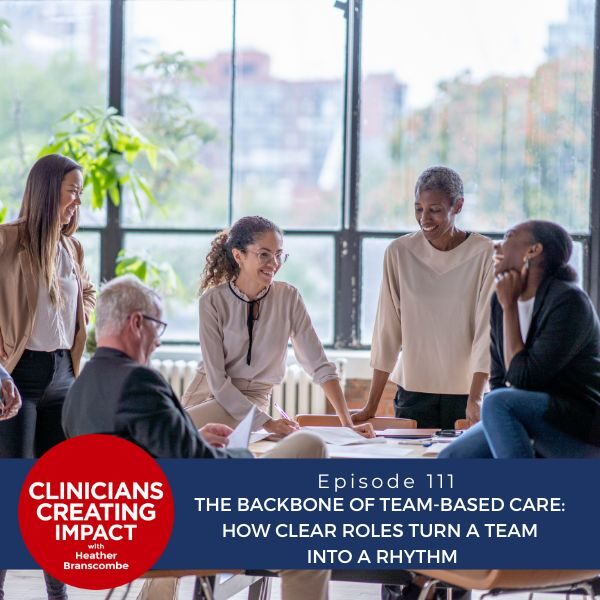
Episode 111, The Backbone of Team-Based Care: How Clear Roles Turn a Team into a Rhythm.
Welcome to Clinicians Creating Impact, a show for physical therapists, occupational therapists, and speech-language pathologists looking to take the next step in their careers and make a real difference in the lives of their clients. If you’re looking to improve the lives of neurodiverse children and families with neurological-based challenges, grow your own business, or simply show up to help clients, this is the show for you.
I’m Heather Branscombe, Therapist, Certified Coach, Clinical Director, and Owner of Abilities Neurological Rehabilitation. I have over 25 years of experience in both the public and private sectors, and I’m here to help you become the therapist you want to be, supporting people to work towards their dreams and live their best lives. You ready to dive in? Let’s go.
Welcome back to Clinicians Creating Impact. Today, I’m really excited to talk to you about something simple, powerful, and honestly, in my personal opinion, it’s actually pretty game-changing. And that is clear roles and what it can do with you. So, in the last episode, episode 110, we talked about the heart of working together. This episode is all about the backbone of it. And without it, I’m here to tell you everything gets wobbly. But with it, everything clicks. So let’s get into it.
Here’s the truth about why clear roles matter. When roles aren’t clear, people start guessing. Our brains are really good at that. We create stories about what other people are doing or what we should be doing. And when people guess, they don’t actually guess the same way. So, you’ll see that, and I will see that all the time. Some clinicians will jump in everywhere. They’ll be over-functioning, taking over, over-helping, over-carrying.
And other clinicians might actually hang back, under-functioning, hesitating, trying not to step on toes, trying not to use people that are there to support you in the first place. I say this because I’ve been this. I’ve actually done both in my career.
Early in Abilities, I unintentionally created systems that created the conditions for both as well. Not because anyone, including myself, was doing anything wrong, but just because I wasn’t really aware that clarity was so important, and the truth was clarity wasn’t built into the systems yet. So clarity isn’t just structure. Clarity is relief. It’s calm. It’s that internal exhale when everyone finally knows this is mine, that is yours, and this is ours collectively. And that’s what I want to talk about today because it’s the backbone of team-based care. So let’s break this down a little more simply.
When I think about this in terms of the relationship of a clinician working with a rehabilitation assistant or an assistant in any way, the clinical direction side, that lane looks like assessment, clinical reasoning, planning, decision-making, adjusting the plan, and key communication with clients and families. So, our lane is actually pretty well-defined. It’s guided by health college standards.
But I also want to offer that it can also be clearly guided by your own strengths, your own joy, and where you do your best work. So it doesn’t need to just begin and end with what the college says we need to do. I also want to invite yourself into that and where you show up to do your best work.
So let’s talk about the rehab assistant’s lane. That’s the ‘carrying the plan forward’ side. That lane includes repetition, practice, that relational consistency that we can’t always provide as assessing clinicians. It involves documenting what happens, noticing those subtle changes, and then really helping the generalization of the skills that we’re often trying to help to elicit happen.
So, in real-world time, great rehabilitation assistants aren’t going to replace clinicians. What they do is they multiply your impact. So what is amazing is when we are each clear in our role, that’s where the shared lane can happen. That’s where the rhythm happens, where you have quick updates, small tweaks, talking about – this worked, this didn’t, celebrating progress, and staying aligned. So what you have in this situation are three lanes, one team, and one mission.
So, in order to kind of highlight this, it reminds me of a story of where we had a clinician and a rehabilitation assistant working together with a child who really thrived on routine and repetition. So in this example, the clinician, who was a therapist, led the clinical direction. And the rehabilitation assistant carried that direction between sessions. They built the relationship. They ran the actual sessions, and they gathered meaningful observations.
So because their roles were clear, the child progressed faster, the clinician stayed grounded and energized, and the rehabilitation assistant grew in confidence and skill. And what was amazing about that was it wasn’t luck. It was clarity of the roles that allowed them to create those kind of results.
Now, remember when I said things weren’t always like that at Abilities? I’m here to vulnerably share it hasn’t always been that way. Before we built our current framework, things were, I will say, fuzzier.
So, that looked like sometimes families would ask rehabilitation assistants clinical questions, not because they didn’t like the therapists that were supervising; it’s not like they didn’t like the clinical team, but they were less clear on what the roles were. And clinicians often hesitated to delegate. They didn’t necessarily have the confidence or competence to be able to supervise a rehabilitation assistant. And then on the flip side, the rehabilitation assistants weren’t always sure what they were, quote unquote, allowed to do. So stress ended up filling the space where clarity should have been.
So, once those roles were better and more clearly defined, that tension actually evaporated. People weren’t confused, they were actually confident. So clarity doesn’t actually box people in. When you have clear standards, clear understanding of where your roles begin and end, it actually ends up freeing people up.
So, you probably are in one of two places. Either one, you’re working with an amazing assistant, maybe you are an assistant, or maybe you’re not. So if you’re new to working with assistants, I’d like you to start here. I really want to speak to those clinicians specifically who may be brand new to this.
So again, we work under the direction of health colleges. And because of that, there are standards, very clear standards about what must be done by the clinician and what can be delegated. But within that clarity, there is a lot of room, and I really mean a lot of room, to build clarity beyond those minimums. So, here are some questions that can help you to expand that for yourself in a way that would hopefully be really helpful for you.
Number one, when you’re thinking about working with a client, what work truly needs your clinical expertise? Because yes, college standards tell us a lot. We need to be working on assessment, reasoning, problem-solving, and adjusting plans.
But again, as I mentioned earlier, there’s a second layer that you also get to consider. Where do you feel strong as a clinician? Where do you feel energized as a clinician? And what kind of work feels like your actual best contribution? Because in reality, your lane isn’t just about a have-to where the college begins and ends. It really can also be about, “This is where I shine as a clinician.” When you ask and answer those questions, that’s that next-level clarity that’s going to increase your impact for yourself, for the rehab assistant, and for the clients that you’re serving.
The second question that can be helpful is what work can be carried forward, repeated, or supported by someone else? So this is your delegation lane. But again, delegation isn’t just a task list, it’s actually a relationship. So two things matter here.
First, consider the strengths and availability of your rehabilitation assistant. Just like we’ve considered what you enjoy, there’s the opportunity to think about what do they enjoy? What are they naturally good at? When did they have capacity and what kind of things lights them up? I guarantee, as you use that, you will also get better outcomes and everyone will feel more supported.
There is no one, in my experience, more loyal than an energized and empowered rehabilitation assistant. And while many of these assistants work with us for a long term because they’ve gone to school, there’s another segment of the population who are actually our future colleagues. Those are the ones that are working in this role because they’re preparing to go to graduate-level training to be able to become clinicians just like us. And so this is a way for us to support our future colleagues by empowering them with these kinds of questions.
Second, when you are thinking about the work that can be carried forward, repeated, or supported by someone else, you really want to be honest with yourself. Because sometimes a client feels hard, but hard isn’t always clinical. It’s – sometimes we like to wrap that up because that feels safer.
But sometimes hard is because it’s a mismatch in energy between you and the client. Sometimes it’s a mismatch in the time they really want to come or want to have a session and the time of day that you want to provide sessions. And sometimes it’s a mismatch just in working style.
Again, we often mask these realities as clinical reasons because it feels safer. But when we do that, we either, first, over-function and hold everything ourselves, almost being like a martyr, like we will keep the hard, quote unquote, clients to ourselves. Or second, under-function, maybe we either delegate them to rehabilitation assistants and don’t support them in that way with ever any consideration to them, or we disengage with the client altogether.
But I want to offer you that neither is actually necessary. So delegation becomes clear when you separate the clinical needs from the human needs. Both are important, but as you separate those, it will be clearer as to who is the best fit for each individual client.
The third question you want to ask overall is where would shared communication make things easier? So this is the rhythm lane. So communication at Abilities, for example, is systematically designed to be layered and flexible. So it could be shared notes, short huddles, client care meetings, quick clarifying questions, even non-identifying text updates.
If you’re going to lean one way with communication, I always suggest lean towards over-communication, especially as the clinician, but even as an assistant or support personnel as well. Over-communication builds trust, it prevents drift, and it helps to keep everybody aligned. And if something feels off, unclear, or heavy, communication is usually the first lever that you can use to help to get everybody on track.
Because here’s the good news. You don’t actually need to know everything on day one to be a great rehabilitation assistant or a great clinician supervising an assistant. You don’t need to be perfect and you don’t even need to have a fully built system. You just need the willingness to start with clarity and build from there because clarity grows with practice. Myself and Abilities is a living, breathing testament to that.
So here’s your reflection for today. Where could clearer roles make work lighter and more impactful for you? Where could clarity bring more ease to your work? And where could clarity bring energy back into your day? Finally, where could clarity help the people around you work in their lane more confidently?
Now, if you’re listening from outside Abilities and thinking, hey, this is the kind of team-based care I want to be a part of, of course, you should reach out. I’d love to talk about what working with us could look like for you. Because either way, the heart of this work is always the same. We build better when we build together.
So with that, I’ll give you a sneak peek at the next episode. Next episode, we’re going to be talking about the art of delegation, knowing how and when to involve a rehabilitation assistant as a clinician and how to do it confidently, ethically, and without burnout. I’ll see you there.
Thanks for joining me this week on the Clinicians Creating Impact podcast. Want to learn more about the work I’m doing with Abilities Rehabilitation? Head on over to abilitiesrehabilitation.com. See you next week.
 Follow, rate, and review the podcast!